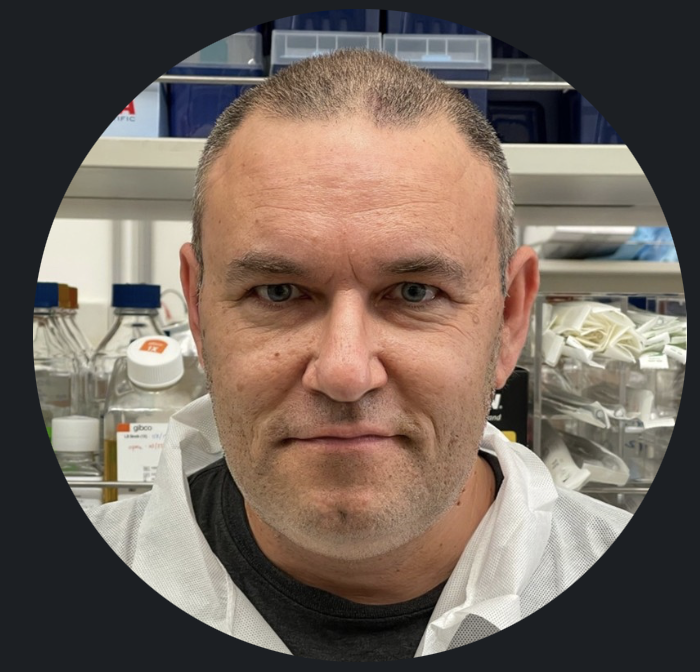
A translational pharmacologist working at the interface of drug discovery and in vivo oncology, Dr. Teper helped develop Metarrestin — a first-in-class inhibitor of the perinucleolar compartment that suppresses metastasis — and now leads the laboratory's preclinical programs on the metabolic drivers of pancreatic cancer.
Metarrestin: drugging the metastatic phenotype
Dr. Teper was part of the multi-institutional team — spanning the National Cancer Institute, NCATS, and Northwestern University — that discovered and advanced Metarrestin, a small molecule identified through a high-content screen of more than 140,000 compounds. Metarrestin disassembles the perinucleolar compartment (PNC), a nuclear body present almost exclusively in highly malignant cells, by inhibiting RNA Polymerase I transcription through an interaction with the elongation factor eEF1A2. In metastatic pancreatic cancer models it suppressed metastatic spread and extended survival with no discernible organ toxicity — work that carried the compound toward first-in-human clinical evaluation.
Background
Dr. Teper's research career bridges chemical biology and cancer pharmacology. His early work centered on identifying and characterizing small molecules that selectively disable the machinery cancer cells rely on to metastasize — culminating in the development of Metarrestin as a perinucleolar compartment inhibitor.
At UCLA, as a project scientist in the Pancreatic Cancer Translational Laboratory, he has turned this drug-development expertise toward the metabolic and microenvironmental biology of pancreatic ductal adenocarcinoma. His current work dissects how obesity and metabolic dysregulation converge — through CREB phosphorylation and downstream signaling — to accelerate tumor initiation and growth, and tests rational drug combinations that interrupt those pathways in genetically engineered mouse models.
Drug-development & targeted-therapy work
Beyond Metarrestin, Dr. Teper co-authored a study mapping how Src family kinase inhibition reshapes signaling in pancreatic cancer cells. The work showed that blocking Src kinases (with dasatinib) paradoxically over-activates the ERK pathway, and that pairing dasatinib with the MEK inhibitor trametinib synergistically shut down colony formation and suppressed tumor growth in vivo — a rationale for combination targeted therapy in PDAC.
Selected publications
Work with the laboratory
Bring this expertise to your program.
Discuss a preclinical in vivo collaboration with our team at UCLA.